Wednesday 21 May 2025, 6 pm UK time / 7 pm CET, online, ZOOM link). Chaired by Monika Szuba (University of Gdańsk) and Petra Johana Poncarová (University of Glasgow / Charles University, Prague).
Programme:
Dana Graham Lai (Simon Fraser University): “The Art of the Weak’: Place and Placelessness in the “Autobiography, poems and songs of Ellen Johnston, ‘the Factory girl'”
Abstract: Ellen Johnston’s autobiography stresses an antithetical link between natural places in her past and urban spaces dictated and manipulated by institutions of power in the present. I will show how Johnston reappropriates the dominant social order with literary tactics that empower her as the self-proclaimed “factory girl.” Her attention to spatial antithesis (the ‘lovely verdant factory’ versus ‘heath clad hills, With thistles waving free’) functions to contest institutional power and shows that Johnston’s lived experience is one of alienation and separation from place—Johnston is ‘placeless’ living a divided life between herself and the world.
Alexander Dick (University of British Columbia): “Island Lords: Walter Scott, Coastal Poetics, and the Politics of Infrastructure”
Abstract: This paper reads Walter Scott’s last narrative poem, The Lord of the Isles (1815), as an instance of coastal poetics. By coastal poetics I mean, first, and adapting the anthropologist Brian Larkin’s notion of “infrastructural poetics,” the unified effort of artists, politicians, scientists, economists, geographers, and landowners to construct and legitimate (legally, rhetorically, and aesthetically) coastal regions into bases of resource extraction: fish, coal, and soldiers. Second, and in a more literary register, coastal poetics comprehends how an awareness of the material realities of coastal life, particularly those of indigenous communities can disassemble coastal infrastructures’s “technological sublime” (as Michele Speitz calls it) and expose its ties to setter-colonial domination. Scott’s sublime descriptions of the Hebridean coasts in the poem imagine them as sites of potential resource extraction; a reading confirmed by the poem’s regular uptake in geological surveys and travel writing in the decades after its publication. But in its many references, both to Scottish history and to contemporary events, including Scott’s own voyage around Scotland’s coasts in 1814, The Lord of the Isles also provides an opportunity to interrogate this uptake critically and to elucidate both its epistemological tensions and its colonialist implications.
Speakers
Dana Graham Lai is a PhD student in Simon Fraser University’s Department of English in British Columbia. She holds an MA in Interdisciplinary Humanities from Trinity Western University and an MA in English Literature from Carleton University. Dana views nineteenth-century Scottish women’s writing through an eco- and/or geo-critical lens and focuses on theories of space and place within that framework. Dana’s research is funded by a Canada Graduate Scholarship (Doctoral) by the Social Sciences and Humanities Research Council of Canada.
Alexander Dick is Associate Professor in the Department of English Language and Literatures at the University of British Columbia in Vancouver. He is the author of Romanticism and the Gold Standard: Money, Literature, and Economic Debate in Britain 1790-1830 (Palgrave 2013) and of many articles and chapters on literature, philosophy, and political economy. He has co-edited two collections of essays, Spheres of Action: Speech and Performance in Romantic Culture (Toronto 2009) and Theory and Practice in the Eighteenth Century: Writing Between Philosophy and Literature (Pickering and Chatto 2008), as well as the Broadview edition of Sheridan’s Pizarro (2018). He is now researching and writing eighteenth-century and Romantic-period literature on the Highland Clearances, on the “coastal poetics” of the Hebridean islands, and on Scottish-Indigenous encounter. He has also recently co-edited (with Eric Gidal) a special issue of Eighteenth-Century Studies on ‘Eighteenth-Century Coasts’ which will appear in Fall 2025.
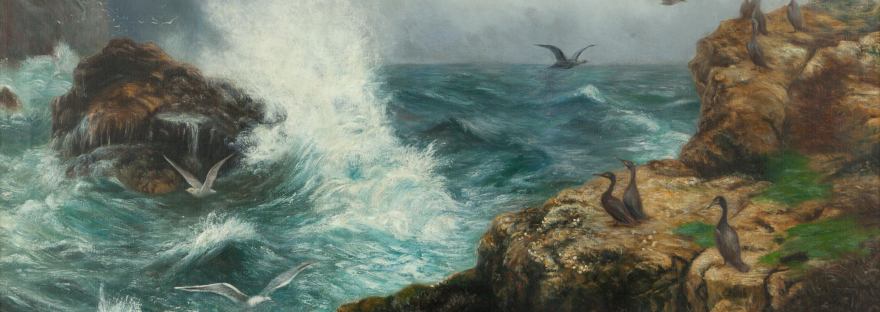
Image: Peter Graham (1836–1921), Cormorants of the Scottish Coast (Wikimedia Commons)

 INTERNATIONAL ASSOCIATION FOR THE STUDY OF SCOTTISH LITERATURES