Environmental Scotland III

Wednesday 21 May 2025, 6 pm UK time / 7 pm CET, online, ZOOM link). Chaired by Monika Szuba (University of Gdańsk) and Petra Johana Poncarová (University of Glasgow / Charles University, Prague).

Programme:

Dana Graham Lai (Simon Fraser University): “The Art of the Weak’: Place and Placelessness in the “Autobiography, poems and songs of Ellen Johnston, ‘the Factory girl'”

Abstract: Ellen Johnston’s autobiography stresses an antithetical link between natural places in her past and urban spaces dictated and manipulated by institutions of power in the present. I will show how Johnston reappropriates the dominant social order with literary tactics that empower her as the self-proclaimed “factory girl.” Her attention to spatial antithesis (the ‘lovely verdant factory’ versus ‘heath clad hills, With thistles waving free’) functions to contest institutional power and shows that Johnston’s lived experience is one of alienation and separation from place—Johnston is ‘placeless’ living a divided life between herself and the world.

Alexander Dick (University of British Columbia): “Island Lords: Walter Scott, Coastal Poetics, and the Politics of Infrastructure”

Abstract: This paper reads Walter Scott’s last narrative poem, The Lord of the Isles (1815), as an instance of coastal poetics. By coastal poetics I mean, first, and adapting the anthropologist Brian Larkin’s notion of “infrastructural poetics,” the unified effort of artists, politicians, scientists, economists, geographers, and landowners to construct and legitimate (legally, rhetorically, and aesthetically) coastal regions into bases of resource extraction: fish, coal, and soldiers. Second, and in a more literary register, coastal poetics comprehends how an awareness of the material realities of coastal life, particularly those of indigenous communities can disassemble coastal infrastructures’s “technological sublime” (as Michele Speitz calls it) and expose its ties to setter-colonial domination. Scott’s sublime descriptions of the Hebridean coasts in the poem imagine them as sites of potential resource extraction; a reading confirmed by the poem’s regular uptake in geological surveys and travel writing in the decades after its publication. But in its many references, both to Scottish history and to contemporary events, including Scott’s own voyage around Scotland’s coasts in 1814, The Lord of the Isles also provides an opportunity to interrogate this uptake critically and to elucidate both its epistemological tensions and its colonialist implications.


Speakers

Dana Graham Lai is a PhD student in Simon Fraser University’s Department of English in British Columbia. She holds an MA in Interdisciplinary Humanities from Trinity Western University and an MA in English Literature from Carleton University. Dana views nineteenth-century Scottish women’s writing through an eco- and/or geo-critical lens and focuses on theories of space and place within that framework. Dana’s research is funded by a Canada Graduate Scholarship (Doctoral) by the Social Sciences and Humanities Research Council of Canada.

Alexander Dick is Associate Professor in the Department of English Language and Literatures at the University of British Columbia in Vancouver. He is the author of Romanticism and the Gold Standard: Money, Literature, and Economic Debate in Britain 1790-1830 (Palgrave 2013) and of many articles and chapters on literature, philosophy, and political economy. He has co-edited two collections of essays, Spheres of Action: Speech and Performance in Romantic Culture (Toronto 2009) and Theory and Practice in the Eighteenth Century: Writing Between Philosophy and Literature (Pickering and Chatto 2008), as well as the Broadview edition of Sheridan’s Pizarro (2018). He is now researching and writing eighteenth-century and Romantic-period literature on the Highland Clearances, on the “coastal poetics” of the Hebridean islands, and on Scottish-Indigenous encounter. He has also recently co-edited (with Eric Gidal) a special issue of Eighteenth-Century Studies on ‘Eighteenth-Century Coasts’ which will appear in Fall 2025. 


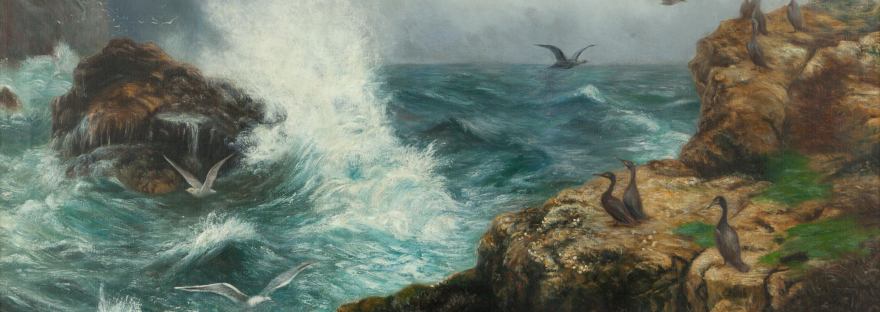
Image: Peter Graham (1836–1921), Cormorants of the Scottish Coast (Wikimedia Commons)

Online Roundtable: Working in the Scottish Archives, At Home and Awa’

Thursday, 5 December 2024, 18:00-20:00 GMT/BST (online, ZOOM)

Facilitator: Steve Newman, Temple University

SPEAKERS:

Kate Hill, University of Lincoln: The home-made archive: women and DIY museums in twentieth-century Scotland

It is frequently asserted that archives are disciplinary formations, categorising people and controlling knowledge through their professional staff and structures. But what about archives that were not professional, structured or even conceived of as archives? I will discuss the material – documents, images and objects – collected by non-professional women who founded folk museums in Scotland; particularly Isabel Grant of the Highland Folk Museum and Barbara Fairweather of Glencoe Folk Museum. These archives, partial, haphazard and idiosyncratic, speak to the affective, embodied and place-based experiences of the past sought by these modern Scottish women, grounding their own, quite mobile, lives in a sense of rootedness.

Brianna E. Robertson-Kirkland, Royal Conservatoire of Scotland: No Man is an Island: Archival Finds and The Corri Family in Edinburgh

The Italian émigré, Domenico Corri (1746-1825), has long been depicted by musicologists and historians as a leading musical figure and entrepreneurial businessmen following his immigration to Edinburgh in 1771. A key secondary source for musicologists, Oxford Music Online, even states that he was invited to conduct the Edinburgh Musical Society concerts, that he ‘quickly established business enterprises’, and that ‘he started a music publishing business with his brother Natale in the name of his eldest son John (or Giovanni)’.[1] While he had multiple business ventures, recent archival evidence has shown that John was not his son but rather his brother, who worked in collaboration with him to publish Domenico’s first treatise before John (not Domenico) entered into a partnership with James Sutherland to establish the publishing house, Corri and Sutherland. Indeed, such inaccuracies have unfairly elevated Domenico’s status to leading musical figure above any of his other family members. The new archival evidence reveals that it was the family as a whole that worked together to establish the Corri name as respectable performers and publishers in Scotland’s capital.

This presentation will focus on two of Domenico’s family – his wife, Francesca (1750?-1802) and his brother, Giambattista otherwise known as John (1760?-1798), both of whom came with Domenico to Edinburgh in 1771. I will discuss what led to the misinformation surrounding these two figures and show archival evidence that proves they were just as active in Edinburgh’s musical community as Domenico. Such discoveries allow for a more nuanced and accurate understanding of both the Corri family and the professional musical performance and publishing world of eighteenth-century Edinburgh.

Craig Lamont, University of Glasgow: Allan Ramsay: an intensely local archive

The works of Allan Ramsay (1684–1758) are in large part a product of his professional and social life in Edinburgh, where he laid many foundations for the heyday of the Scottish Enlightenment. In this paper, we will see how Ramsay’s archives in Edinburgh have shaped the new Edinburgh Edition of his works (completed in 2024), and the extent to which his writing – in English and in Scots, in poetry and in prose – touches these crucial years of Scotland’s intellectual growth.

Nigel Leask, University of Glasgow, and Peadar Ó Muircheartaigh, University of Edinburgh: The MacNicol Papers: ‘From Lismore to Barbados’ and Beyond

This talk arises out of archival research for the AHRC funded project ‘From Lismore to Barbados’: The Gaelic Caribbean Travel Journal and Poetry of Dugald MacNicol, 1791-1844’. Initial research for the project was conducted remotely during the Covid Lockdown: key archival sources were the MacNicol Papers in the National Library of Scotland; Probate Court records in the National Archive at Kew; Army Lists; Barbados Archives Department (for information on his family life in the Caribbean); University College London’s Legacies of British Slavery Database. We also benefited greatly from contact with Barbadian genealogists during that period of research. Further Barbados archival research remains to be done during a planned research visit in 2025.

In this short talk we will focus on the transnational, colonial history of the MacNicol archive itself. Now preserved in the National Library of Scotland, much of the collection was compiled by Rev Donald MacNicol (1735–1802), but travelled with his sons to both the West, and East Indies during the 19th century where it was added to. The Gaelic folklorist John Francis Campbell, who was given access to the collection by Donald MacNicol’s grandson Ludovic Cameron in 1870, describes how his uncle, Dugald MacNicol ‘had the papers in the West Indies, and made some notes upon them … An elder brother of Dugald, who went to Calcutta and Australia, may have had some of his father’s papers … It is said that one of the family lost a portmanteau in the West Indies by the upsetting of a boat, and that he then lost some of the Gaelic manuscripts’. This talk will explore some of these adventures and misadventures, setting the surviving MacNicol papers in the NLS in dialogue with archives elsewhere.


[1] Peter Ward Jones and Rachel E. Cowgill, “Corri, Domenico,” Grove Music Online, 2001; Accessed 30 Sep. 2024. https://www.oxfordmusiconline.com/grovemusic/view/10.1093/gmo/9781561592630.001.0001/omo-9781561592630-e-90000380703.

Registration: World Congress of Scottish Literatures 2024

The fourth World Congress of Scottish Literatures, hosted by the School of English at the University of Nottingham, will take place from Wednesday 3rd to Sunday 7th July 2024.

Both the School of English and the city of Nottingham enjoy a richly interlinked history with Scotland and Scottish writing. The School has particular specialist research in Older Scots, Romanticism, literary Modernism, and in the contemporary. Nottingham and its Midlands environs recur in the writing of Walter Scott; Byron’s ancestral home of Newstead Abbey lies just north of the city; J. M. Barrie earned a living writing for the Nottingham Journal; and the University holds the papers of Catherine Carswell. We even make an appearance in Trainspotting.

We hope that the Congress will be an opportunity to continue the mission of the International Association for the Study of Scottish Literatures, to bring together scholars from all over the world situate Scotland in a global and transnational scope.
Hosting the Congress south of the border also offers us an opportunity to revisit the historical relationship between England and Scotland, and the effect that collaboration has had on the world. Nottingham, meanwhile, is indelibly marked by an outlaw imagination, and we are looking forward to a Congress held in that spirit.

Environmental Scotland II

Following the Environmental Scotland webinar organised by Carla Sassi (University of Verona) in September 2021, ‘Environmental Scotland II’ gathers various viewpoints and approaches toward a topic that has long been central in Scottish literatures. The invited panelists are Timothy C. Baker (University of Aberdeen), Léna Ferrié (University of Western Brittany), Peter Mackay (University of St Andrews) and Camille Manfredi (University of Western Brittany). Organised and chaired by Monika Szuba (University of Gdańsk), the webinar will take place on Monday 22 April 2024 at 5 pm CET.