On behalf of the family, Isla Jack said: Each year, we take great heart from the people researching in the fields of reception and diaspora in Scottish Literatures who also take the time to submit their work for this award established in Ronnie’s memory. Again, they have provided us with a diverse range of research to consider, spanning different continents, authors and perspectives. Our warmest congratulations go to Eleoma Bodammer as the seventh recipient of the Jack medal, and hope others are encouraged to continue to respond to this year’s call for applications.’
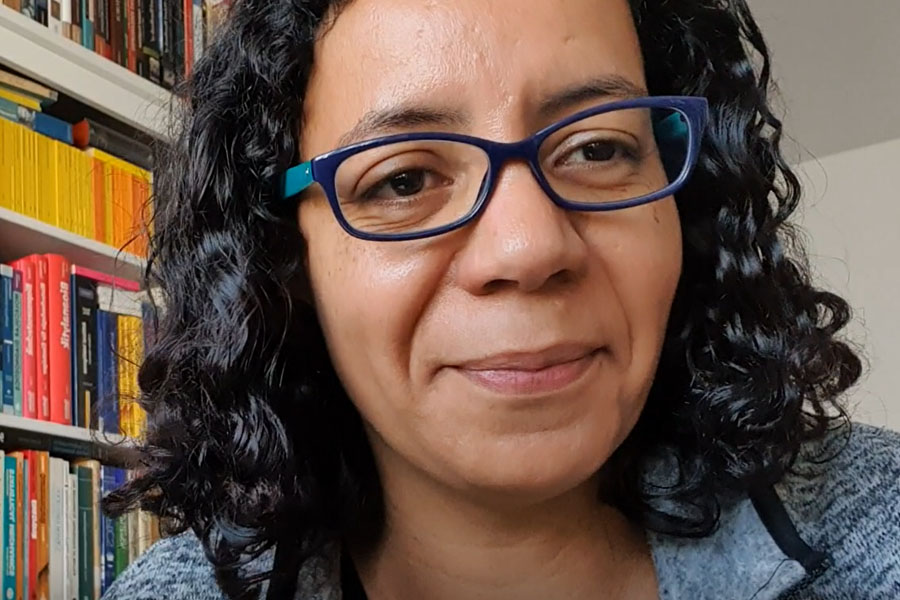
Eleoma Bodammer (University of Edinburgh) was awarded the Jack Medal for the chapter ‘John Stuart Blackie (1809-1895): Translating Faust I in Scotland (1834),’ published in Deutsch-Britischer Kulturtransfer im Vormärz, ed. Andrew Cusack (Bielefeld: Aisthesis Verlag, 2024)
Statement: “I am absolutely delighted to have been awarded the 2024 Jack Medal for my chapter ‘John Stuart Blackie (1809-1895): Translating Faust I in Scotland (1834),’ which was published in the book Deutsch-britischer Kulturtransfer im Vormärz [German-British Cultural Transfer in the Vormärz], edited by Andrew Cusack (Bielefeld: Aisthesis Verlag, 2024). At a time when Modern Languages departments across the UK are under the considerable pressure of cuts and closures, it seems timely that the 2024 Jack Medal committee has chosen to recognise research that focuses on the historical importance of language learning abroad, the significance of the knowledge of literature, culture, and history for the development of language and translation skills, the value of literary translation, and Scotland’s strong cultural connections with Europe.
My chapter focuses partly on the ways in which the Scottish Professor John Stuart Blackie introduced German literature to British readers, and partly on one of his most important achievements, his metrical English translation of Johann Wolfgang von Goethe’s play Faust I (1808), published in 1834. Blackie held the Chair of Greek at the University of Edinburgh (1852-1882) but had a life-long passion for the German language and German literature that originated while pursuing his studies as a young man at the universities in Göttingen and Berlin in Germany (1829-1830). Alongside Thomas Carlyle (1795-1881), Blackie became a prolific cultural mediator of German literature in Scotland, and published essays, translations and book reviews in British periodicals that created a significant context for the emerging academic field of German Studies in Scotland in the nineteenth century. A central focus in my chapter is Blackie’s contribution to nineteenth-century translation theories and I concentrate on his use of metaphors in his translator’s preface to Faust I in order to explain his translation approach. I draw on Rainer Guldin’s classification system for translation metaphors in order to interpret Blackie’s ideas about translation.
I would like to thank the British Academy for supporting this research in the form of a Small Research Grant, shared with Professor Essaka Joshua (University of Notre Dame), and the AHRC for awarding me a Research Fellowship to work on my project ‘Scottish-German Cultural Exchange’.”

Gioia Angeletti (University of Parma) was awarded the Honourable Mention for the article ‘Scottish Literature of Migration and Transculturality: Subversive Reticence and Gender Negotiations in Lady Anne Barnard’s Cape Writings,’ published in La questione Romantica 15: 1/2 (December 2023).
Statement: ‘I am profoundly honoured and moved to receive an Honourable Mention in the Jack Medal for the 2024 award season for my article “Scottish Literature of Migration and Transculturality: Subversive Reticence and Gender Negotiations in Lady Anne Barnard’s Cape Writings”. This recognition is especially meaningful to me, not only as the culmination of years of dedicated research on Anne Barnard (née Lindsay, 1750–1825)—a fascinating yet often overlooked figure—but also as an impetus to further explore her work in the context of one of my central academic interests: the intricate negotiations, exchanges, and tensions that arise in cross-cultural encounters. So, I am sincerely grateful to the Award Committee for their support and encouragement, which reaffirm my commitment to the study of Scottish literature of migration and exile. This award also offers me the opportunity to acknowledge my profound debt to the Institute of Advanced Studies in the Humanities (IASH) in Edinburgh, which, thanks to a fellowship in the summer of 2022, allowed me to immerse myself in the Barnard archives at the National Library, delving deeply into her life and writings. I fell in love with Scottish literature as a student at the University of Bologna in the late 1980s, before exploring it further during my Erasmus and PhD years in Glasgow in the 1990s, and since it was my beloved and greatly missed friend, Andrew Hook, who nurtured and sustained my enthusiasm for this field, it is to his memory that I dedicate this award, with gratitude and affection.’
 INTERNATIONAL ASSOCIATION FOR THE STUDY OF SCOTTISH LITERATURES