Kang-yen Chiu (National Yang Ming Chiao Tung University, Taiwan) was awarded the 2025 Jack Medal for the chapter ‘“Drifting down the Stream of a Deep and Smooth River”: Translation and Film Adaptation of Ivanhoe in the Modern History of Taiwan,’ published in the collective monograph Scotland and China: Literary Encounters (SCROLL, De Gruyter Brill, 2025), edited by Daisy Li Li and John Corbett.
The Honourable Mention was awarded to Sarah Sharp (University of Aberdeen) for the article ‘The Settler Colonial Cotter: Situating “The Cotter’s Saturday Night” in Post-Revolutionary America’ which was published in the special issue of the Burns Chronicle on ‘Robert Burns and North America.’
On behalf of the Jack family, Isla Jack said: ‘The articles submitted for this year’s Jack Medal provided us once more with high quality, scholarly research covering a diverse range of authors, continents and perspectives. It is heartening to see that the field of reception and diaspora in Scottish Literatures continues to flourish in this way. We congratulate both Kang-yen Chiu as the eighth recipient of the Medal and Sarah Sharp for her Honourable Mention. We continue to be touched that researchers submit their work for this award in Ronnie’s name, and hope others are inspired to respond to the 2026 call for applications.’
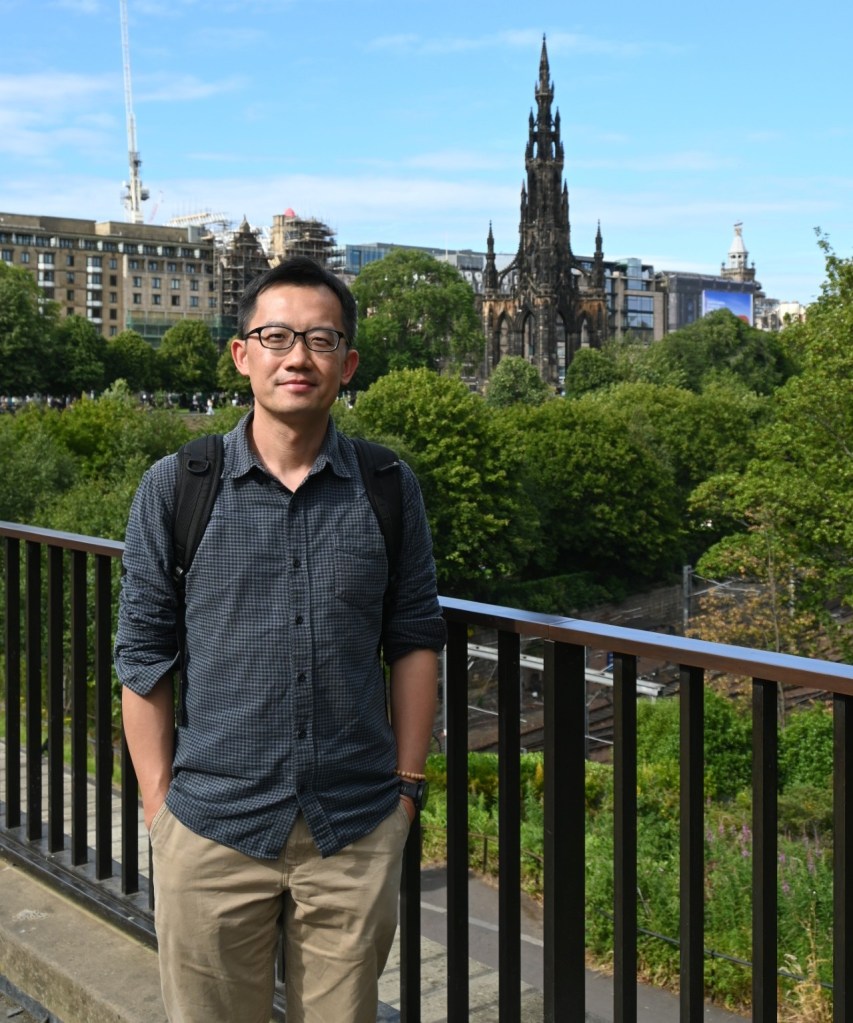
Kang-yen Chiu’s statement: I am deeply honoured to receive the 2025 Jack Medal for my chapter ‘“Drifting down the Stream of a Deep and Smooth River”: Translation and Film Adaptation of Ivanhoe in the Modern History of Taiwan.’ This research traces the reception of Ivanhoe in Taiwan by examining its critical history, its translations, and the enduring influence of the 1952 film adaptation. By situating the novel’s popularity within the legacy of May Fourth intellectual debates, the chapter considers how the narrative of Saxon resistance to Norman rule has been recontextualised as a resonant metaphor for local identity and the region’s complex historical experience.
My connection to Scotland began when I was ten, through the kindness of my first Scottish family—Bert and Stella. What began as a childhood encounter has grown into an enduring bond, and Scotland has remained at the heart of both my life and my intellectual journey ever since. Since completing my doctorate, I have sought to devote my academic career to the advancement of Scottish literary studies in the Chinese-speaking world, and to sharing with students and readers a literary tradition from which I have benefited profoundly. I am sincerely grateful to the Award Committee; this distinction not only recognises my work but also reaffirms, in a deeply meaningful way, my commitment to the field.
This work has come to fruition through the support of many. I remain indebted to the education I received at the University of Glasgow and to an academic community whose encouragement and inspiration have sustained my research over the years. I am also grateful to the National Science and Technology Council (Taiwan) for its continued support. Finally, my deepest thanks go to my parents, my beloved wife, Min-ching, and my children—your unwavering companionship is my greatest strength.

Sarah Sharp’s statement: I am absolutely delighted to have been awarded the Honourable Mention for my article ‘The Settler Colonial Cotter: Situating “The Cotter’s Saturday Night” in Post-Revolutionary America’. Since completing my doctorate my research has been centred on Scotland’s relationship with the colonial world. Every year I have been excited to read and learn from the work of those honoured by the Jack Prize committee. It is very special to now receive this recognition.
My work would not have been produced without a great deal of support and scholarly generosity. I have benefitted from the guidance of many brilliant scholars in this field including Liam McIlvanney at the Centre for Irish and Scottish Studies in Otago, Anthony Jarrells and Patrick Scott at University of South Carolina, and Porscha Fermanis at University College Dublin.
This article was a contribution to the special issue of the Burns Chronicle ‘Robert Burns and North America.’ I would like to acknowledge the generous support and capacious vision of the issue editors, Arun Sood and Ronnie Young. The initial materials for this article were gathered during my time at the University of South Carolina as a Scottish Studies Scholar and I would like to thank the Fulbright Commission for their support of this research.
 INTERNATIONAL ASSOCIATION FOR THE STUDY OF SCOTTISH LITERATURES